Last Updated: October 26, 2026
Quick Summary
Golf coaching for busy professionals works best as one lesson every two to three weeks, with two or three short solo sessions in between. A simulator lesson is the most efficient format because tracking data lets an instructor diagnose faults in minutes, and a workable practice plan fits inside three hours a week.
- Book a fixed lesson slot first, then build the rest of your week around it.
- Simulator lessons are weather-proof, so progress does not stall from November through March.
- Split weekly practice into a 45-minute skill block, a 30-minute putting block and a 60-90 minute simulator round.
- Short sessions work when they have one measurable target, like the 20-minute putting ladder.
- Ask whether instructors are PGA-certified and whether the facility tracks ball flight and club data.
Table of Contents
- Why Golf Coaching Fits a Busy Professional's Schedule
- Golf Simulator Lessons: The Most Efficient Way to Get Better
- How Often to Take Golf Lessons When Your Calendar Is Full
- Building a Golf Practice Plan for Busy Golfers
- Short Golf Practice Sessions That Still Move Your Handicap
- What to Look for in Golf Coaching Near Edgewater, NJ
- Book Your First Coaching Session at Edge Golf
- Frequently Asked Questions
Why Golf Coaching Fits a Busy Professional's Schedule
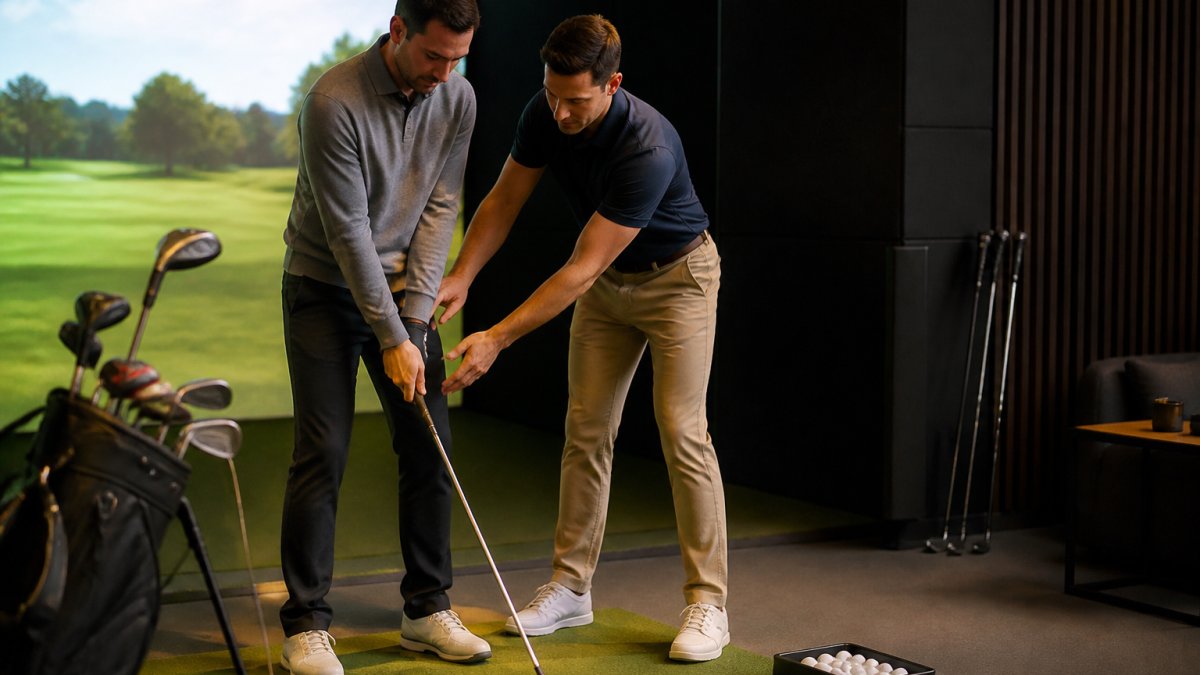
Golf coaching for busy professionals works because it replaces scattered, low-value range time with short, focused sessions that fit around a demanding calendar. At Edge Golf in Edgewater, NJ, a packed week leaves no room for a five-hour round, but a focused hour of tracked practice still moves the needle.
Here is the honest version of the problem. Most golfers who want to improve do not lack effort. They lack a structure that survives a real work week. A free Saturday gets eaten by a client call, the range session gets pushed, and six weeks pass with no measurable change. Coaching fixes that because it adds two things a solo range session never has: a defined objective and someone watching the numbers.
The time problem coaching actually solves
A common mistake is treating practice as something that happens only when the calendar opens up. It rarely does. Coaching flips the order: you book a fixed slot first, then build the rest of the week around it. One committed hour with a PGA-certified instructor beats four unfocused hours alone, because every swing has a purpose and a measurable result.
That reframe matters for professionals in particular. You already schedule meetings you cannot move. Treat the lesson the same way and the practice actually happens.
Golf Simulator Lessons: The Most Efficient Way to Get Better
Golf simulator lessons are the highest-return coaching format for anyone short on time. A simulator bay gives you high-precision tracking of ball flight, club path, and impact position, so an instructor can diagnose a fault in minutes rather than guessing from the naked eye.
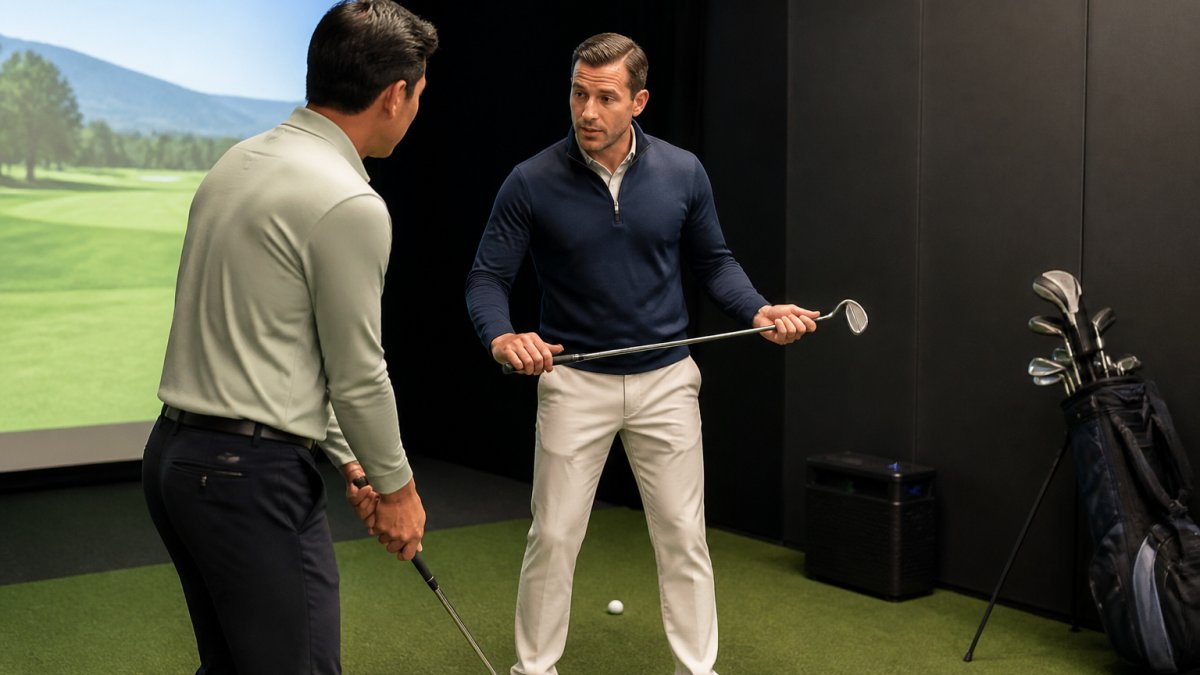
The efficiency argument is simple. Outdoors, you cannot control wind, temperature, or daylight, and you cannot see what your clubhead actually did at impact. Indoors, every variable is repeatable, which means the feedback loop between a swing change and its result is far tighter.
There is a second benefit busy golfers rarely anticipate: simulator work is weather-proof. A cold, rainy stretch in the Northeast does not cancel the lesson, so progress does not stall from November through March. If you want to go deeper on indoor improvement, our guide on how to improve your golf handicap indoors walks through the full approach, and readers weighing their options can compare indoor golf simulator alternatives to the driving range.
How Often to Take Golf Lessons When Your Calendar Is Full
The right cadence for most busy professionals is one lesson every two to three weeks, with two or three short solo sessions in between. That spacing gives a swing change enough repetitions to take hold without demanding a weekly commitment your schedule cannot honor.
Here is how the cadence maps to different schedules:
| Schedule Type | Lesson Frequency | Solo Practice Between | Best Format |
|---|---|---|---|
| Executive with travel | Every 3 weeks | 2 short sessions | Simulator, 60 minutes |
| Hybrid worker | Every 2 weeks | 3 short sessions | Simulator plus putting studio |
| Weekend-only player | Every 2 weeks | 2 sessions | Simulator, 90 minutes |
| Pre-season push | Weekly for 4 weeks | 3 sessions | Simulator plus club fitting |
The pre-season block is the one exception worth making. A short, dense run of lessons before the season starts front-loads the work, then you drop to maintenance mode once you are playing regularly.
Building a Golf Practice Plan for Busy Golfers
A workable golf practice plan for busy golfers fits inside three hours a week and splits into three short blocks: one skill block, one putting block, and one on-course or simulator round. The plan fails when it tries to cover everything at once.
Structure beats volume. Here is a template we would hand to any professional with a full calendar:
- Block 1 (45 minutes): Full swing on the simulator, working only on the single correction from your last lesson
- Block 2 (30 minutes): Putting and short game, using PuttView-style feedback to groove distance control
- Block 3 (60-90 minutes): Nine holes on a simulator course, played with a specific scoring focus rather than casual swinging
Short Golf Practice Sessions That Still Move Your Handicap
Short golf practice sessions move your handicap when they have a single measurable target, not when they are a bucket of balls hit on autopilot.
Try these three formats when you only have a small window:
- The 20-minute putting ladder: Putt from three distances, tracking how many finish inside a club length. Score it every session.
- The 15-minute wedge matrix: Hit five shots each to three target distances. Note the dispersion, not just the good ones.
- The 10-minute swing check: Three swings with a single thought, checked against the tracking data, then stop.
What to Look for in Golf Coaching Near Edgewater, NJ
The best golf coaching near Edgewater, NJ, combines certified instruction, tracking technology that shows real data, and a location you will actually travel to on a weeknight.
When you evaluate a coaching program, ask these questions before you commit:
- Are the instructors PGA-certified, or self-taught coaches?
- Does the facility track ball flight and club data, or rely on video alone?
- Can you book lessons in the evening and on weekends?
- Is the location reachable from Manhattan without a car?
- Do you get a written summary of what to practice between sessions?
Readers who also want their equipment dialed in can follow our 5 steps to find golf club fitting near me, since a lesson on ill-fitted clubs only gets you so far.
For professionals commuting from Manhattan, the geography is a genuine advantage. Edgewater sits just across the Hudson, which makes a weeknight session realistic.
Book Your First Coaching Session at Edge Golf
The fastest way to test whether coaching fits your week is to book one session and see how it feels. At Edge Golf, our PGA-certified instructors work with players of every level in a premium indoor setting, and you can book a small-group golf lesson for up to three players with weekly themes from driving to short game and putting.
Here is what makes the format work for a full calendar. Six Golfzon simulator bays and four private rooms mean you can practice year-round regardless of weather, with automatic hands-free ball feed so you spend your hour swinging rather than teeing up. A PuttView putting studio handles the short game, and high-precision tracking gives you measurable feedback after every session. VIP members get priority booking and exclusive nights, which matters when your only free slot is a Thursday evening.
Get started with Edge Golf and turn a packed schedule into steady, measurable progress on your handicap.
Frequently Asked Questions
How often should a busy professional take golf lessons?
A lesson every two to three weeks works for most professionals who also practice between sessions. That spacing gives you time for two or three short practice blocks before the next lesson, so the instructor can build on what you worked on rather than repeating it. Players preparing for a specific event or making a swing change may benefit from weekly sessions for a month or two, then spacing them out once the change holds up under pressure.
How can I improve my golf game with limited practice time?
Focus on short, structured sessions instead of long range trips. Three 30-minute blocks per week are often more effective than one three-hour session. Use a golf practice plan for busy golfers that assigns one specific skill per session, such as putting inside 10 feet on Monday, wedge distances on Wednesday, and driver accuracy on Friday. Indoor simulator time lets you work on full swing and putting in the same visit, which cuts travel and setup time.
Are indoor golf simulator lessons effective for improving your game?
Yes. Simulators track club path, face angle, ball speed, and launch direction, giving the instructor objective data on every swing. That turns a lesson from a conversation about feel into a measurable plan. Golf simulator lessons also let you practice year-round regardless of weather, which matters in the New York metro area where outdoor ranges close or become unplayable for months. The key is choosing a facility with accurate tracking and a PGA-certified instructor who knows how to interpret the numbers.
What should I look for in a golf coach in Edgewater, NJ?
Look for PGA certification, experience teaching adults with limited practice time, and access to tracking technology that measures your swing rather than just describing it. Ask how the coach structures lessons for players who can only practice 60 to 90 minutes per week, and whether they provide a written practice plan between sessions. A facility with simulator bays, a putting studio, and club fitting under one roof saves you from juggling multiple locations, which matters when your schedule is tight.
If your week already feels full, the answer is not more practice hours. It is better-placed ones. Book a session, let a certified instructor find the one fault worth fixing, and build a short practice routine around it. That is how busy professionals actually get better at golf.
