Table of Contents
- What Serious Golfers Should Look For in an Indoor Golf Simulator
- Top Indoor Golf Simulators in New Jersey for Serious Practice
- How Accurate Are Indoor Golf Simulators for Serious Practice?
- Golf Simulator Club Fitting Services: What to Expect
- PGA-Certified Golf Coaching in NJ: What Serious Improvement Looks Like
- Pricing, Memberships, and Booking: What to Ask Before You Commit
- Conclusion: Choosing the Right Simulator for Year-Round Practice
- Frequently Asked Questions
Last Updated: October 13, 2026
What Serious Golfers Should Look For in an Indoor Golf Simulator
The best indoor golf simulators in New Jersey for serious practice combine accurate ball tracking, a bay wide enough to swing driver freely, and putting feedback that transfers to real greens. At Edge Golf in Edgewater, NJ, we built our facility around those three priorities, because they are what separate a practice tool from an arcade game.
Serious players ask sharper questions than casual ones. They want to know what the launch monitor actually measures, whether the lie punishes a fat shot the way turf does, and whether the numbers hold up on the course in April.
Tracking Technology and What It Measures
Indoor golf simulator accuracy depends on the sensor system. Camera-based and infrared-laser systems capture club path, face angle, ball speed, launch angle, and spin. Radar systems read ball flight but can struggle in tight indoor spaces.
What matters for practice is spin data. Without it, you cannot diagnose why a shot curved. Ask any facility which metrics its system reports before you book.
Bay Size, Lie Quality, and Ball Feed
An 18-foot-wide bay lets you hit driver without flinching. Narrow bays force you to aim defensively, which builds bad habits.
Lie quality matters just as much. True-to-course turf reacts to a steep strike the way real fairway does. Automatic hands-free ball feed keeps a practice session moving without bending down between every shot.
Top Indoor Golf Simulators in New Jersey for Serious Practice
Here are the venues we would send a serious player to, ranked by how well each supports structured practice rather than casual play.
Edge Golf, Edgewater
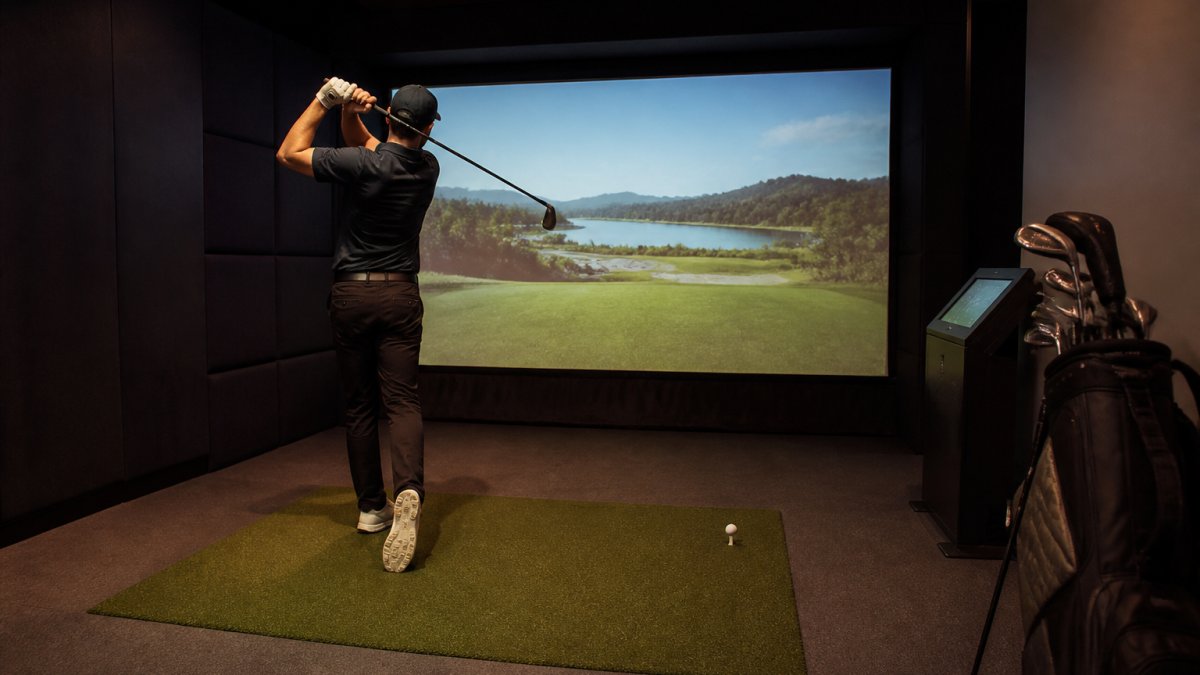
Edge Golf is our top pick for serious practice in Northern New Jersey. Six Golfzon simulator bays and four private rooms cover everything from a solo range session to a full corporate event, and the PuttView putting studio lets you work on the one part of the game most simulators ignore.
PGA-certified instructors handle coaching and golf simulator club fitting services, so the data you generate in a bay turns into an actual equipment decision. Players can practice on more than 300 famous courses with automatic hands-free ball feed and true-to-course lies.
The location is minutes from Manhattan, which matters if you work in the city and want a standing weekly session.
Tee Performance Indoor Golf, Sussex County
Tee Performance runs 18-foot-wide AboutGolf simulators, one of the wider bays on this list. That width is a real advantage if you are working on driver dispersion.
The trade-off is distance. Sussex County is a haul from the Hudson River towns, so it suits players already living in that part of the state.
X-Golf Denville, Denville
X-Golf Denville uses camera systems paired with infrared lasers, a combination that reads both club and ball well. The Denville location is convenient for Morris County players.
Where it falls short: the franchise format is built around social play, so expect a livelier room than a dedicated practice bay.
Golf Kings NJ, Toms River
Golf Kings NJ operates as an indoor simulator lounge at 111 West Water Street in Toms River. It is a solid Ocean County option when you want a relaxed indoor round.
The facility does not publish simulator specifications, so call ahead if tracking data is your priority.
Greens Indoor Golf & Cafe, Millburn
Greens Indoor Golf & Cafe appears in Millburn-area listings as a golf lessons business, which tells you instruction is central to what they do. If you want coaching rather than solo reps, that focus helps.
Review volume is thin, so treat the rating as a starting point, not a verdict.
The Golf Den and Go Low Indoor Golf, Paramus Area
| Facility | Area | Tracking System | Best For |
|---|---|---|---|
| Edge Golf | Edgewater | Golfzon | Full practice: bays, putting studio, fitting |
| Tee Performance | Sussex County | AboutGolf, 18-ft bays | Wide-bay driver work |
| X-Golf Denville | Denville | Camera + infrared laser | Morris County convenience |
| Golf Kings NJ | Toms River | Not published | Ocean County lounge rounds |
| Greens Indoor Golf & Cafe | Millburn | Not published | Lesson-focused players |
| The Golf Den / Go Low | Paramus area | Not published | Casual local sessions |
How Accurate Are Indoor Golf Simulators for Serious Practice?
Modern indoor golf simulators are accurate enough for meaningful practice, provided the system reads spin and the bay gives you room to swing. The gap between simulator and course narrows every year, but it never closes completely.
Three variables drive the difference:
- Sensor type. Camera and laser systems read more data points than basic radar indoors.
- Bay geometry. Cramped bays distort how you swing, not how the system reads it.
- Mat firmness. A soft mat hides fat shots that real turf would punish.
Golf Simulator Club Fitting Services: What to Expect
A proper fitting session uses your actual ball flight data to match shaft, lie angle, and loft to your swing. Indoor fitting works because the launch monitor captures the same metrics an outdoor fitting would, minus wind and temperature.
Here is what a useful session looks like:
- Warm up for 15 minutes before any data is recorded
- Hit your current clubs first to establish a baseline
- Test at least three shaft options on the same head
- Compare dispersion, not just distance
- Ask for the data sheet before you leave
If a fitter skips the baseline step, the numbers you get back are not comparable to anything.
PGA-Certified Golf Coaching in NJ: What Serious Improvement Looks Like
PGA-certified golf coaching NJ players can trust starts with a baseline assessment and ends with measurable change. The certification matters because it confirms a coach has completed PGA training in swing mechanics, equipment, and player development.
What separates good coaching from a wasted hour:
- Video or simulator data captured at the start and revisited weeks later
- A written practice plan you can follow between sessions
- Clear benchmarks, such as fairways hit or putts per round
Pricing, Memberships, and Booking: What to Ask Before You Commit
Pricing at indoor golf facilities depends on bay time, peak hours, and whether coaching or fitting is included. Rates vary widely across New Jersey, so we do not quote numbers here. Contact each facility directly for current rates.
Ask these questions before you commit:
- What is the cancellation policy on a membership?
- Are peak evening hours included or surcharged?
- Does membership include priority booking?
- Is there any credit back on bookings?
At Edge Golf, VIP members get priority booking, exclusive nights, and 1% back on every booking, which softens the cost of a regular practice habit.
Conclusion: Choosing the Right Simulator for Year-Round Practice
New Jersey winters do not have to cost you a season of progress. The right indoor setup keeps your swing sharp from November through March, and the wrong one just rents you a screen for an hour.
Look for accurate tracking, a bay wide enough to swing freely, and coaching that produces data you can act on. Edge Golf in Edgewater offers six Golfzon bays, a PuttView putting studio, PGA-certified instruction, and club fitting, all minutes from Manhattan.
Book a session at Edge Golf and find out what your swing actually does when the weather stops interfering.
Frequently Asked Questions
Are indoor golf simulators accurate enough for serious practice?
Modern systems like Golfzon use high-speed cameras and infrared sensors to track club path, ball speed, launch angle, and spin. For serious players, the key is whether the facility offers true-to-course lies and automatic ball feed, which reduce setup variables between shots. Accuracy varies by system, so ask which technology a facility uses before committing to a membership. Edge Golf's Golfzon bays with hands-free ball feed let you hit repeated shots without repositioning, which keeps practice sessions consistent.
What features should I look for in a professional-grade golf simulator?
Prioritize tracking technology (camera and infrared systems generally outperform older sensor mats), bay width, lie quality, and whether the facility offers putting analysis. A PuttView putting studio, like the one at Edge Golf, adds green-reading and stroke data that most standard bays do not provide. Also check course library size, private room availability for focused sessions, and whether coaching or club fitting is offered on-site. These features separate a practice facility from an entertainment venue.
Do indoor golf facilities in New Jersey offer club fitting services?
Some do, but availability varies. Club fitting at an indoor facility typically uses simulator data (ball speed, launch angle, spin rate, dispersion) to match shaft flex, loft, and lie angle to your swing. Edge Golf in Edgewater offers PGA-certified club fitting alongside its simulator bays, which means you can test clubs under the same tracking conditions you practice in. Call ahead to confirm whether fitting is included with a session or booked separately.
Can I get PGA-certified coaching at indoor golf centers in NJ?
Yes, several New Jersey indoor facilities employ PGA-certified instructors, though not all do. Coaching at an indoor center usually combines simulator data with video analysis, so you see swing changes measured in numbers rather than feel alone. Edge Golf's PGA-certified instructors work with players of all levels, from beginners to low-handicap golfers, and sessions can focus on specific weaknesses like driver dispersion or putting stroke consistency. Ask about instructor credentials and whether progress is tracked over multiple sessions.
How does the Golfzon simulator technology compare to other systems?
Golfzon is known for true-to-course lies, meaning the hitting surface adjusts to simulate uphill, downhill, and sidehill shots you would face outdoors. Many competitor systems use a flat mat regardless of lie. Golfzon also offers automatic hands-free ball feed, so you do not bend down or reposition between shots. For serious practice, the combination of variable lie and consistent ball feed makes sessions more realistic and efficient. Edge Golf operates six Golfzon bays in Edgewater, giving members access to this technology year-round.