
Table of Contents
- Why Purposeful Practice Beats Hitting Balls
- Build Your Golf Practice Plan with a Weekly Schedule
- A Complete Golf Practice Routine: Blocked vs. Random Practice
- Essential Golf Practice Drills for Every Skill Level
- How to Practice Golf at Home Without a Range
- Measure Your Progress: Metrics That Matter
- Common Practice Mistakes and How to Fix Them
- Frequently Asked Questions
Last Updated: October 5, 2026
Why Purposeful Practice Beats Hitting Balls
Most golfers who want to improve their game assume that more range time equals better scores. It rarely works out that way.
Purposeful practice is training with a defined target, a specific shot in mind, and a way to measure whether you actually pulled it off.
The gap between practice and performance comes down to feedback. When every swing has a target and a consequence, your brain starts building the patterns that hold up under pressure.
The 70/30 Rule: Scoring Shots vs. Full Swing
Here is where most practice routines quietly fall apart. The average golfer spends the majority of range time hitting driver and mid-irons, the two clubs that account for the fewest strokes on a scorecard. Flip that ratio.
Aim for roughly 70% of your practice time on scoring shots (wedges, chipping, pitching, putting) and 30% on full swing. Approach shots and short game are where strokes are actually saved.
Build Your Golf Practice Plan with a Weekly Schedule
A golf practice plan works best when it is written down, time-boxed, and tied to one or two specific goals. Random range sessions produce random results. A structured week, even a short one, compounds over a season.
Start by naming the outcome you want. Lower your handicap by three strokes? Break 90 for the first time? Then reverse-engineer the skills that get you there.
Match the Plan to Your Time Budget
Most golfers overestimate how much time they have. Build the plan around what you will actually do, not what sounds impressive. Three tiers cover almost everyone:
- Minimal (2-3 hours per week): Two 45-minute sessions plus one 9-hole loop. Focus on one skill per session and accept slow progress.
- Standard (5-6 hours per week): Three 60-minute range or short-game sessions plus one 18-hole round or simulator session. This is the sweet spot for most working golfers.
- Competitive (8-10 hours per week): Four 90-minute sessions, one on-course round, and one dedicated short-game block. Only sustainable if you have a specific tournament or handicap goal.
Sample Weekly Schedule for Beginners vs. Advanced Players
The table below assumes a Standard time budget. Scale session lengths up or down to fit your tier, but keep the ratio of short game to full swing intact.
| Day | Beginner (60 min) | Advanced (90 min) |
|---|---|---|
| Monday | Putting stroke, 20 min; lag putting to 3-foot circle, 20 min; full swing with one club, 20 min | Blocked iron work on one technical change, 30 min; wedge distance ladder, 30 min; putting gate drill, 30 min |
| Wednesday | Chipping and pitching, 30 min; pre-shot routine reps with 7-iron, 30 min | Random target practice across 5 clubs, 40 min; up-and-down ladder, 30 min; pressure putting, 20 min |
| Friday | Full swing with one club, 30 min; putting tempo drill, 30 min | Wedge distance control, 30 min; 9-shot window, 30 min; 5-ball pressure finish, 30 min |
| Weekend | 9 holes or simulator round with one scoring goal | 18 holes or course simulation with full pre-shot routine on every shot |
Beginners should keep sessions short and repeatable. Advanced players need more variation and more pressure. Both groups benefit from a pre-shot routine on every single ball, even in practice.
How to Progress the Plan Every Four to Six Weeks
A plan that never changes stops producing gains. Once a skill becomes automatic, the session that built it is now maintenance, not development. Rotate your focus on a four-to-six-week cycle:
- Weeks 1-2: Blocked work on the new skill, short random blocks to test transfer.
- Weeks 3-4: Shift the ratio toward random practice and add a pressure element to every session.
- Weeks 5-6: Test the skill on the course. If it holds, promote it to maintenance and pick the next weakness.
Keep a one-line note after each session: what you worked on, what improved, what still breaks down. That log is what tells you when to rotate.
A Complete Golf Practice Routine: Blocked vs. Random Practice
Use blocked practice when you are making a technical swing change. Repetition without variation lets you groove a new movement pattern. Use random practice once the change feels stable, because it mimics how golf is actually played.
Research on motor learning consistently shows that random practice produces worse results during the session but better retention and transfer to competition. That trade-off is worth understanding.
A balanced routine might look like this:
- Warm-up: 10 minutes of wedges, gradual distance increase
- Blocked block: 15 minutes on the one technical change you are working on
- Random block: 20 minutes alternating clubs and targets
- Pressure finish: 5 balls with a consequence for a miss
Essential Golf Practice Drills for Every Skill Level
Good golf practice drills share three traits: a clear target, a scoring method, and a way to add pressure. A drill without a target is just a swing.
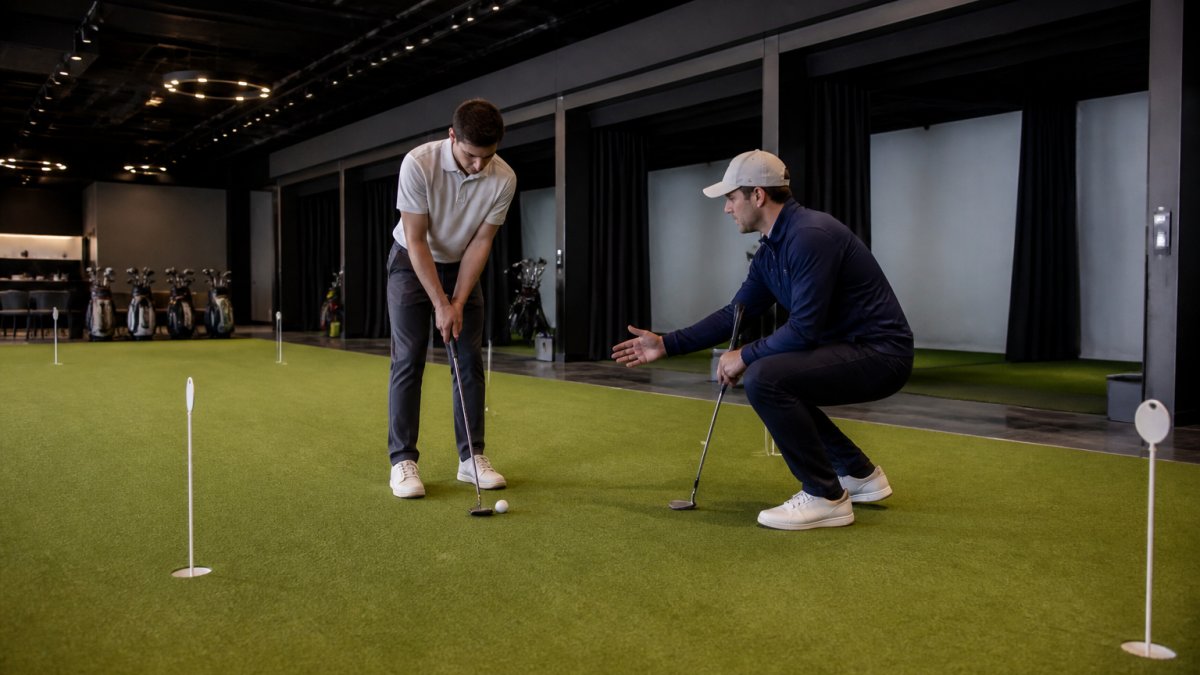
Drills for Driving, Iron Play, and Short Game
Driver: Fairway Game. Pick a 30-yard-wide target zone. Hit 10 drives and count how many finish inside it.
Irons: The 9-Shot Window. Choose a target green and hit three shots each at low, medium, and high trajectories.
Short game: Up-and-Down Ladder. Place five balls at increasing distances from the pin.
Putting: Metronome Drill. Set a metronome or use a counting rhythm to build consistent tempo.
How to Practice Golf at Home Without a Range
You can build real skill without ever leaving your house, and for players in cold-weather months, that matters.
For putting, a simple indoor mat and a straight edge are enough.
For full swing, the metronome drill and slow-motion rehearsals work well. Swing at half speed with a mirror or phone camera to check positions.
If you want true-to-course feedback without weather concerns, an indoor facility closes the gap.
Measure Your Progress: Metrics That Matter
Improvement you cannot measure is improvement you cannot trust. The metrics that matter most are the ones tied to scoring, and the key is to track them the same way every time so the numbers are comparable week to week.
The Core Scorecard Metrics
Track these four after every round. Use a rolling five-round average, not a single round, because one bad day tells you nothing.
- Putts per round. Count every putt, including putts from the fringe if you use the putter. A common benchmark for mid-handicap players is 32-36 putts per round; breaking 30 usually signals real short-game improvement.
- Greens in regulation (GIR). A green is hit in regulation when your ball is on the putting surface in par-minus-two strokes or fewer. Tour players average roughly 12 GIR per round; a 15-handicap commonly sits around 5-7. Track the number, not the percentage, until you have ten rounds of data.
- Up-and-down percentage. Count every missed green where you got down in two or fewer strokes. Divide successes by total attempts. Anything above 50% is strong for an amateur.
- Penalty strokes. Count every stroke added by a lost ball, water, or out-of-bounds. This number is the fastest to fix and the most ignored.
Practice-Session Metrics
Scorecard numbers tell you what happened. Session numbers tell you why. Record these after each practice block:
- Putting make rate. From 3 feet, 6 feet, and 10 feet, hit 10 putts each and record makes. A useful target is 9/10 from 3 feet, 6/10 from 6 feet, and 3/10 from 10 feet. If 3-footers drop below 8/10, that is your next practice priority.
- Proximity to target. For wedge work, measure the average distance from the hole for 10 shots at a fixed yardage. Track it over a month; the trend matters more than any single session.
- Dispersion. For driver and irons, note how many shots finish inside your intended target zone. A 30-yard-wide fairway zone is a reasonable starting target for driver.
- Strike quality. If you have access to a launch monitor, log club path, face angle, and ball speed. If you do not, use impact tape or foot spray on the clubface and count how many shots finish near the center.
Turning Numbers into a Practice Plan
The point of tracking is to decide what to practice next. A simple rule: whichever metric is furthest below the benchmark becomes the focus of your next two-week block. If your 3-foot make rate is 7/10 and your GIR is 6, the putter gets the time first, because the fix is faster and the strokes saved are immediate.
Keep a simple log. After each session, note one thing that improved and one thing that needs work. Over a month, patterns emerge that no single session would reveal.
Common Practice Mistakes and How to Fix Them
The biggest mistake in golf practice is repetition without feedback. Hitting 100 balls with no target, no measurement, and no consequence builds nothing but fatigue.
The second mistake is practicing only what you are already good at. It feels rewarding and it changes nothing. Spend your time on the weakest part of your game, even when it is uncomfortable.
The third is ignoring the mental side. On the course, you get one shot, not five.
Frequently Asked Questions
What is the best golf practice routine?
A balanced golf practice routine mixes full swing, short game, and putting in every session. Start with a 10-minute warm-up, then spend 20 minutes on full swing, 20 minutes on wedges and chipping, and 15 minutes on putting. Include at least one random practice block where you vary clubs and targets to simulate on-course conditions. This structure builds skill across all areas and keeps you engaged.
How often should you practice golf to improve?
Most golfers see steady improvement with three to four focused sessions per week, each lasting 45 to 60 minutes. Quality matters more than quantity: a 30-minute session with clear targets and feedback beats a two-hour mindless range session. If you can only practice once a week, prioritize short game and putting, which have the biggest impact on scoring.
How can you practice golf at home?
You can practice golf at home with a putting mat, a chipping net, and a mirror for swing checks. Focus on pre-shot routine, alignment, and tempo. Use a metronome drill to groove consistent tempo, and practice slow-motion swings to reinforce swing changes. Even 15 minutes a day of focused home practice can improve your ball striking and consistency.
What should you work on first when practicing golf?
Start with your short game and putting, because they account for over half of your score. The 70/30 rule suggests spending 70% of practice time on shots inside 100 yards (including putting) and 30% on full swing. This ratio quickly lowers your handicap. Once your short game is reliable, shift more time to full swing and course simulation.
How do you make a golf practice session more effective?
Make every practice session effective by setting a specific goal, using targets, and tracking results. Warm up with a purpose, then use blocked practice for technique changes and random practice for skill transfer. End with a pressure drill that mimics on-course consequences. Review your data after each session to identify patterns and adjust your next practice plan.
Golf improvement is not about finding more hours in the week. It is about making the hours you already have count, with a plan, a target, and honest feedback on every shot. Edge Golf was built for exactly that: six Golfzon simulator bays, a PuttView putting studio, PGA-certified instructors, and high-precision tracking that turns practice into measurable progress, all year round and just minutes from Manhattan. Book a session at Edge Golf and start practicing with a purpose.